
Which Swiss Banks Dominate Google AI Search? (French-Speaking Switzerland)
Google is now answering your customers’ banking questions before they reach your website.
The question is not whether this changes your acquisition model — it does. The question is which Swiss banks are shaping those answers, and which ones have been written out of the conversation entirely.
We analyzed 374 French-language keywords covering retail banking in French-speaking Switzerland.
For each keyword: does Google trigger an AI Overview? Which banks does it mention? Which websites does it trust as a source?
Here’s what we found:
- Which banks Google mentions most and which are completely invisible
- Why blogs and aggregators earn more AI citations than the banks themselves
- Where neobanks are beating traditional banks at the conversion moment
- What content formats actually earn Google AI citations
- Five concrete steps Swiss banks should take now
Why this study? To understand which banks Google’s AI trusts
What is a Google AI Overview?
When a French-speaking Swiss customer types “quelle est la meilleure banque en ligne en Suisse?” into Google, they may no longer reach a list of ranked websites first. Instead, Google’s AI generates its own answer, a paragraph or a structured response that sits above every organic result.
That answer is called an AI Overview. It is not an advertisement. It is not a website ranking. It is Google deciding to answer the question itself, using its own AI, drawing on content it has already crawled.
AI Overviews are now the primary first-contact moment for a meaningful share of banking queries.
For Swiss banking marketers, the implication is direct: the customer’s initial impression of the competitive landscape is being shaped by an AI-generated answer before any bank gets a chance to present its own case.
En Suisse romande, les banques en ligne les plus recommandées sont Neon, Yuh et UBS. Neon et Yuh se distinguent par l’absence de frais mensuels et des taux d’épargne compétitifs — Neon à 1.00% et Yuh à 1.30% par année. UBS offre une gamme complète de services, mais avec des frais de tenue de compte. Pour les expatriés, Alpian propose le taux le plus élevé à 1.50%.
What is inside an AI Overview?
Two metrics define AIO performance in this study.
Brand mentions are the banks Google names inside the AI-generated answer. “UBS, Yuh, and Neon offer competitive savings rates” counts as three brand mentions. Being mentioned means Google considers you relevant to the question. It is the minimum bar.
Source citations are the websites Google links at the bottom of the AI answer or the domains it used to construct the response. Being cited as a source is the higher-value outcome.
You are not just named; Google’s AI used your content to build the answer. Your domain is shaping what Google tells customers about the entire category.
The critical distinction: a bank can be mentioned in 30% of AI Overviews and still have zero source citations. Google talks about you, but uses someone else’s website to do it.
That gap, between being a noun in the answer and being an authority behind it, is what this study exposes.
What we measured
374 French-language keywords grouped into six topic categories covering the full spectrum of retail banking decisions in the Romand market.
For every keyword where Google triggered an AI Overview, we recorded which brands appeared and which domains were cited.
What are French-speaking Swiss banking customers searching for?
We grouped the 374 keywords into six topic categories.
Individual keywords do not tell a useful story: “meilleur compte épargne Suisse” and “quel taux d’épargne en Suisse” are different queries but the same customer need.
Grouping by topic reveals which decisions Google’s AI is involved in, not just which words trigger it.
| Category | Keywords | % of corpus | Dominant intent | Example queries |
|---|---|---|---|---|
| Bank Selection & Everyday Banking | 167 | 44.7% | Informational | “Quelle est la meilleure banque en ligne en Suisse ?”, “Quelle banque prendre en Suisse ?” |
| Mortgages & Real Estate Financing | 56 | 15.0% | Informational | “Quel est le meilleur taux hypothécaire en ce moment ?”, “Quelle banque accorde le plus de prêts hypothécaires ?” |
| Pension & Retirement Planning (3rd Pillar) | 51 | 13.6% | Informational | “Quel est le meilleur 3e pilier en Suisse ?”, “Quelle banque pour le 3ème pilier ?” |
| Investing, Wealth Management & Markets | 43 | 11.5% | Informational | “Quelle est la meilleure banque privée suisse ?”, “Quelle est la meilleure plateforme de cryptomonnaies en Suisse ?” |
| Savings Accounts & Interest Rates | 34 | 9.1% | Informational | “Quel est le taux d’épargne en Suisse ?”, “Où placer mon argent en Suisse ?” |
| Banking Safety, Regulation & Trust | 23 | 6.1% | Informational | “Quel est le montant garanti par la protection des dépôts en Suisse ?”, “Quelles sont les banques les plus sûres en Suisse ?” |
The biggest category by a wide margin is Bank Selection, nearly half the entire corpus.
These are top-of-funnel queries: the customer has not chosen a bank yet. That is where AI Overviews carry the most influence.
A customer typing “quelle banque prendre en Suisse” is not browsing, they are forming a consideration set.
If your bank is not in Google’s AI answer at that moment, you are not in their consideration set.
How often does Google answer with AI and what Swiss banks does it cite?
The overall AIO trigger rate across all 374 keywords is 48.4%.
Nearly half of all banking-related searches in French-speaking Switzerland now surface an AI-generated answer before any website.
This is not a niche feature at the margins of the SERP. It is the default experience for close to half of all banking queries.
The trigger rate varies significantly by topic:
| Category | AIO trigger rate | #1 brand | #1 source domain | Avg brands per AIO |
|---|---|---|---|---|
| Bank Selection & Everyday Banking | 47.9% | Neon (35.0%) | thepoorswiss.com (16.3%) | 7.4 |
| Savings Accounts & Interest Rates | 58.8% | Crédit Agricole (35.0%) | moneyland.ch (30.0%) | 4.2 |
| Mortgages & Real Estate Financing | 57.1% | UBS (50.0%) | bonasavoir.ch / moneypark.ch / resolve.ch / ubs.com (tied at 15.6%) | 4.1 |
| Pension & Retirement Planning | 45.1% | VIAC / finpension / UBS / Raiffeisen (tied at 21.7%) | finpension.ch (21.7%) | 4.8 |
| Investing, Wealth Management & Markets | 55.8% | Pictet / UBS (tied at 37.5%) | mustachianpost.com (33.3%) | 9.5 |
| Banking Safety, Regulation & Trust | 56.5% | UBS (53.8%) | moneyland.ch / ubs.com (tied at 23.1%) | 4.2 |
Two things jump out immediately.
The categories with the highest AIO trigger rates, savings at 58.8%, mortgages at 57.1%, banking safety at 56.5%, are all dominated by non-bank source domains.
Aggregators and independent blogs, not official bank websites, are what Google trusts most in the highest-activity categories.
Second, the most brand-crowded categories (investing at 9.5 brands per AIO, bank selection at 7.4) are also the ones where source authority is most fragmented. Being named is easy in these categories. Being the source is not.
Bank Selection & Everyday Banking
| Metric | Result |
|---|---|
| Keywords | 167 (44.7% of corpus) |
| AIO trigger rate | 47.9% |
| Avg brands per AIO | 7.4 — the most crowded category |
| Intent split | 66.5% informational, 28.7% commercial, 4.8% transactional |
| Top 5 brands | Neon (35.0%), Yuh (32.5%), UBS (30.0%), Banque Migros (25.0%), Revolut (22.5%) |
| Top 5 sources | thepoorswiss.com (16.3%), moneyland.ch (12.5%), ubs.com (11.3%), mavieensuisse.ch (10.0%), alpian.com (8.8%) |
The top source in the most important category is an independent expat personal finance blog, not a bank.
Google is describing Swiss banking options using third-party editorial voices as its primary authority. No single bank’s own website leads the sourcing.
The intent split makes this more than academic: 28.7% commercial intent, 4.8% transactional. AI Overviews in this category are not just informing customers, they are directly influencing account-opening decisions.
Savings Accounts & Interest Rates
| Metric | Result |
|---|---|
| Keywords | 34 (9.1% of corpus) |
| AIO trigger rate | 58.8% — the highest in the study |
| Avg brands per AIO | 4.2 |
| Intent split | 88.2% informational, 8.8% commercial, 2.9% transactional |
| Top 5 brands | Crédit Agricole (35.0%), UBS (25.0%), Raiffeisen (25.0%), BCV (20.0%), Alpian (20.0%) |
| Top 5 sources | moneyland.ch (30.0%), ca-nextbank.ch (25.0%), alpian.com (20.0%), mustachianpost.com (15.0%), thepoorswiss.com (10.0%) |
This is the most open category in the corpus.
The highest AIO rate combined with a fragmented source landscape, moneyland.ch leads at only 30.0%, no source near dominant. It means the authority structure is genuinely contestable.
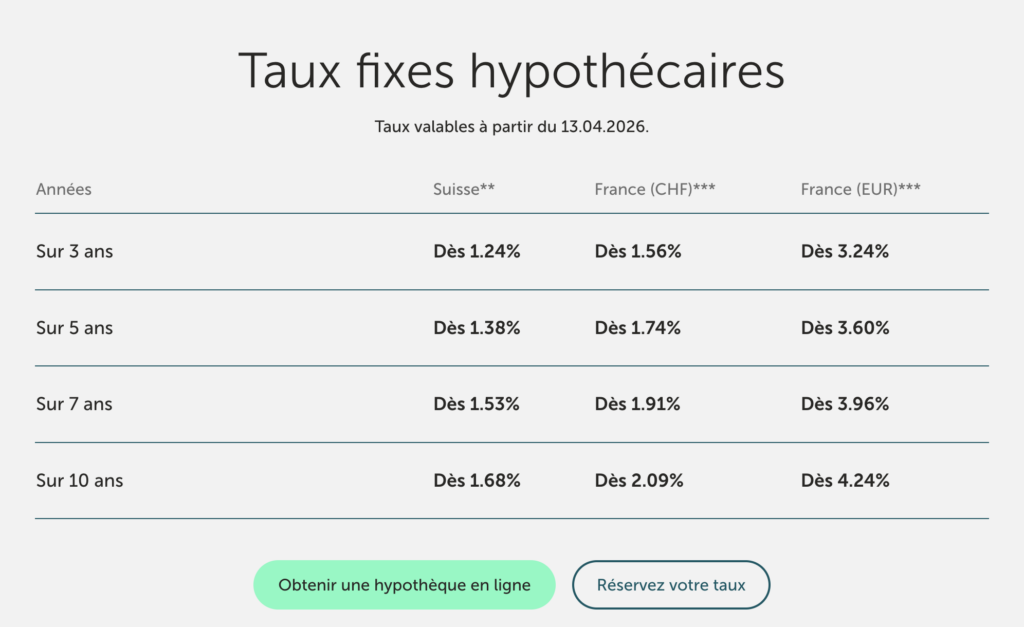
One number worth sitting with: ca-nextbank.ch earns 25.0% source visibility in this category through a single, regularly updated rate page. One structured page doing the work.
Mortgages & Real Estate Financing
| Metric | Result |
|---|---|
| Keywords | 56 (15.0% of corpus) |
| AIO trigger rate | 57.1% |
| Avg brands per AIO | 4.1 |
| Intent split | 82.1% informational, 14.3% commercial, 3.6% transactional |
| Top 5 brands | UBS (50.0%), Comparis (21.9%), MoneyPark (15.6%), Raiffeisen (15.6%), PostFinance (15.6%) |
| Top 5 sources | bonasavoir.ch (15.6%), moneypark.ch (15.6%), resolve.ch (15.6%), ubs.com (15.6%), ca-nextbank.ch (12.5%) |
UBS dominates brand mentions at 50.0%, twice the rate of any competitor. But source authority is genuinely open: four domains tied at 15.6%, none dominant.
The presence of moneypark.ch and resolve.ch, broker and advisory sites, not lenders at the same level as ubs.com is the structural signal that matters here.
Structured advisory content about Swiss mortgage rules (SARON versus fixed rates, minimum down-payment requirements, amortization rules) outperforms product pages in this category.
Google’s AI is sourcing process explanations, not product brochures.
Pension & Retirement Planning
| Metric | Result |
|---|---|
| Keywords | 51 (13.6% of corpus) |
| AIO trigger rate | 45.1% |
| Avg brands per AIO | 4.8 |
| Intent split | 82.4% informational, 11.8% commercial, 5.9% transactional |
| Top 5 brands | VIAC (21.7%), finpension (21.7%), UBS (21.7%), Raiffeisen (21.7%), PostFinance (17.4%) |
| Top 5 sources | finpension.ch (21.7%), moneyland.ch (17.4%), mustachianpost.com (17.4%), postfinance.ch (13.0%), viac.ch (13.0%) |
The great equalizer. Two fintechs with no branch network. VIAC and finpension, match UBS and Raiffeisen exactly at 21.7% AIO brand visibility.
finpension.ch leads domain sourcing at 21.7% while most traditional bank domains do not appear as sources at all.
The mechanism is straightforward: finpension.ch answers the comparison question directly — “finpension vs VIAC vs bank 3a, which is better?” — while traditional bank pension pages describe their own product.
Google cites the one that answers the user’s actual question.
Investing, Wealth Management & Markets
| Metric | Result |
|---|---|
| Keywords | 43 (11.5% of corpus) |
| AIO trigger rate | 55.8% |
| Avg brands per AIO | 9.5 — the most brand-dense category |
| Intent split | 62.8% informational, 34.9% commercial, 2.3% transactional |
| Top 5 brands | Pictet (37.5%), UBS (37.5%), Lombard Odier (29.2%), Julius Baer (25.0%), Swissquote (25.0%) |
| Top 5 sources | mustachianpost.com (33.3%), vermoegenszentrum.ch (20.8%), schweizerfinanzblog.ch (12.5%), ubs.com (12.5%), finpension.ch (8.3%) |
mustachianpost.com earns source citations in 33.3% of AIO responses in this category, more than Pictet, UBS, Lombard Odier, or any of the private banks whose names dominate the brand mentions column.
Google trusts an independent personal finance blog over institutions with centuries of Swiss private banking history when it comes to sourcing answers about wealth management.
That is not a quirk of the algorithm. It is a content quality verdict. The blog answers the question the reader typed. The private bank website describes the bank.
Banking Safety, Regulation & Trust
| Metric | Result |
|---|---|
| Keywords | 23 (6.1% of corpus) |
| AIO trigger rate | 56.5% |
| Avg brands per AIO | 4.2 |
| Intent split | 92.3% informational, 7.7% commercial, 0% transactional |
| Top 5 brands | UBS (53.8%), ZKB (30.8%), BCV (30.8%), Raiffeisen (30.8%), FINMA (15.4%) |
| Top 5 sources | moneyland.ch (23.1%), ubs.com (23.1%), thepoorswiss.com (15.4%), bwo.admin.ch (7.7%), finma.ch (7.7%) |
This is where customers ask whether their money is safe — “quel est le montant garanti par la protection des dépôts en Suisse?”, “est-ce que les banques suisses sont soumises à la FINMA?”
UBS appears in 53.8% of AIO responses in this category despite being associated with the 2023 Credit Suisse rescue, a clear signal that AIO brand visibility is driven by content volume and structure, not by recent reputational events.
ZKB and BCV each appear as brand mentions at 30.8%, but neither bank’s own website appears as a cited source. FINMA’s own domain appears in fewer than 8% of responses in a category entirely about regulatory safety.
A bank that publishes a clear, structured guide to Swiss deposit protection, explaining the esisuisse guarantee, the CHF 100,000 limit, and the difference between cantonal bank state guarantees and private bank guarantees, would be filling a documented information gap in the highest-trust category in the corpus.
Does search intent change what Swiss banks Google cites?
Not all searches are equal. Someone researching “what is a 3rd pillar” is in a different moment than someone typing “open a bank account in Switzerland.”
All 374 keywords were classified by intent, informational, commercial, transactional, to see whether Google’s AI answers behave differently at each stage.
| Intent | Keywords | AIO rate | Top 3 brands | Top 3 source domains |
|---|---|---|---|---|
| Informational | 268 | 50.7% | UBS (35.3%), Yuh (25.0%), Raiffeisen (20.6%) | moneyland.ch (11.8%), ubs.com (11.0%), mustachianpost.com (10.3%) |
| Commercial | 86 | 43.0% | Neon (37.8%), Yuh (37.8%), UBS (35.1%) | thepoorswiss.com (13.5%), comparabanques.fr (13.5%), banque.meilleurtaux.com (10.8%) |
| Transactional | 20 | 35.0% | Neon (57.1%), Yuh (57.1%), UBS (42.9%) | hellosafe.ch (28.6%), moneyland.ch (28.6%), rivaria-capital.com (14.3%) |
Three structural patterns emerge from this.
The funnel shift
UBS leads in informational intent at 35.3%. As intent moves toward conversion, commercial and transactional queries, UBS is overtaken by Neon and Yuh.
At the transactional level, where customers are ready to open an account (“où puis-je ouvrir un compte bancaire gratuit en Suisse?“), Neon and Yuh each appear in 57.1% of AIO responses.
These are branchless banks with marketing budgets a fraction of UBS’s, winning the conversion moment in Google AI search.
They do it because thepoorswiss.com and mustachianpost.com, which rank among the top AIO source domains, publish detailed, named comparisons of Neon and Yuh against traditional banks.
Review-heavy third-party coverage translates directly into AIO source citations and, from there, into brand visibility at the moment a customer decides to act.
Neon serves approximately 237,000 customers; Yuh has grown to over 340,000 users and reached profitability within four years, figures documented in the IFZ study on Swiss bank GenAI visibility.
Their AIO performance is not vanity. It is acquisition infrastructure.
The cross-border risk
Commercial queries are the most strategically dangerous segment for Swiss banking digital teams.
comparabanques.fr and banque.meilleurtaux.com, both French, not Swiss, comparison platforms, each earn 13.5% source visibility in commercial-intent AIO responses, matching the leading Swiss source (thepoorswiss.com, also at 13.5%).
A French aggregator with no Swiss regulatory knowledge, no Swiss banking license expertise, and no awareness of Swiss-specific rules like esisuisse deposit protection is co-authoring the AI answer a Swiss customer receives when they type “quelle banque choisir en Suisse.”
These platforms dominate commercial-intent AIO sourcing because they publish ranked listicles like “meilleures banques en ligne,” “meilleures banques pour les étudiants“, that map directly onto the comparison queries where AIO triggers.
Swiss banks and Swiss comparison platforms have not built equivalent content at scale in this format. The gap is being filled by foreign aggregators, and the resulting market-framing risk is not marginal.
Source thinning at the transactional level
Transactional queries have the thinnest AIO trigger rate (35.0%) and the thinnest source coverage overall.
This is a structural opportunity: banks that publish highly structured, action-oriented pages, account opening guides, step-by-step 3rd pillar enrollment, minimum down-payment calculator, would be answering questions Google currently hands to small advisory sites.
The source landscape at this intent level is open.
Who is the most visible bank in Google AI search?
The category and intent data above shows the landscape in slices. These are the structural patterns across the full 374-keyword corpus.
Half of banking queries now trigger an AI answer
48.4% overall.
The categories where customers make the highest-value decisions, mortgages at 57.1%, savings at 58.8%, banking safety at 56.5%, trigger AIO more than the average.
Google is most active exactly where the stakes are highest. If your acquisition strategy assumes customers reach your website before forming an opinion, that assumption needs to be revisited.
Banks aren’t the source. Blogs and aggregators are
Content type breakdown across all AIO source citations:
- comparison and aggregator platforms (23.0%),
- official brand websites (21.8%),
- independent finance blogs (20.2%),
- broker and advisory sites (12.6%),
- news and press (10.6%),
- expat sites (6.7%),
- social and video (3.4%).
Non-brand sources account for 78.2% of all AIO citations.
For the typical Swiss bank, Google answers questions about their products by citing someone else roughly four times out of five.
Remove ubs.com and alpian.com from the brand website category, and the official brand website share collapses to near zero. moneyland.ch appears in 11.0% of all AIO responses across all six categories. mustachianpost.com at 8.8%. thepoorswiss.com at 8.3%.
These three domains, a Swiss comparison platform and two independent English-language personal finance blogs targeting expats, collectively outperform the entire Swiss banking sector’s editorial output in Google AI sourcing.
UBS leads, but neobanks dominate the conversion moment
UBS appears in 35.9% of all AIO responses across the entire corpus. The only bank cited in all six topic categories.
As an industry benchmark: UBS ranks #7 globally in the 2025 Evident AI Banking Index, with an AI maturity score of 50.2 out of 100.
Its AIO dominance is not accidental. It reflects consistent editorial investment across mortgage rate pages, market commentary, savings disclosures, and wealth management guides that give Google a broad set of citable content across all query types.
For comparison, JP Morgan Chase ranked #1 globally with a score of 79. UBS is Switzerland’s only representative in the global top 10.
Yuh follows at 27.1% of all AIO responses. Neon at 22.7%. Raiffeisen at 19.9%, the most broadly distributed traditional bank, present in every category, leading in none.
Banque Migros at 18.8%, with its no-fee positioning making it a natural comparison candidate for “best low-fee Swiss bank” queries.
PostFinance is the only major traditional Swiss bank other than UBS to achieve cross-category source authority on its own domain (postfinance.ch appears in 6.1% of all AIO-triggered keywords).
Cantonal banks are invisible and it’s a content problem
This is the most concrete finding in the corpus.
Banque Cantonale de Genève (BCGE) appears in 0% of AIO responses across all 374 keywords. Zero brand mentions. Zero source citations.
The largest retail bank headquartered in Geneva, the largest city in the French-speaking Swiss region, does not exist in Google AI search in its own market.
Every customer in Geneva who types a banking question and receives an AI-generated answer is being directed toward Neon, UBS, or comparabanques.fr.
BCGE does not appear in that answer.
BCV (Banque Cantonale Vaudoise) earns 10.5% brand visibility, it appears as a noun in AI answers, including a notable 30.8% in the Banking Safety category.
But bcv.ch earns zero domain source citations across all six categories and all 374 keywords.
Google knows BCV exists. It does not trust BCV’s website to answer questions. The brand appears in the AI answer; the bank’s own content does not shape what that answer says.
Both cases point to the same structural cause: product-and-branch-oriented websites with no editorial layer, no rate comparison content, and no structured informational pages that AIO can parse and cite.
The cantonal banks have regulatory solidity, deep regional trust, and full product breadth. None of that translates into AIO presence without content that answers the questions customers are actually typing.
French platforms are co-authoring Swiss banking answers
comparabanques.fr at 13.5% of commercial-intent AIO source citations. banque.meilleurtaux.com at 13.5%.
Neither is Swiss. Neither has Swiss regulatory expertise.
Both dominate commercial-intent AIO sourcing because they publish ranked comparison listicles that map exactly onto the queries where AIO triggers.
Swiss banks and Swiss comparison platforms have not built equivalent content at scale, and the gap is being filled by foreign aggregators. For a CMO at a Swiss bank, that is not an SEO footnote, it is a market framing problem.
What content earns Google AI citations?
The data shows a consistent pattern across all six categories and three intent types.
Brand size, domain authority, and marketing budget do not earn AIO citations. Content format does.
Four specific content plays appear repeatedly in the source data.
Structured comparison content
moneyland.ch and comparabanques.fr dominate source citations in Bank Selection and commercial intent through ranked comparison tables, bank fees presented side by side, rate comparisons with filter context, editorial summaries that name specific banks and specific advantages.
The format answers the exact question the user typed in a structure that Google can parse and excerpt directly.
The market gap is clearest in Savings Accounts, which has the highest AIO trigger rate in the corpus (58.8%) and no source domain above 30.0%.
A bank that publishes a data-rich savings rate comparison table, listing its own rates alongside peer institutions, updated monthly, with brief editorial context, would enter a category that AIO actively wants to answer but currently sources from aggregators.
There is no entrenched authority to displace.
Regularly updated rate pages
ca-nextbank.ch earns 25.0% source visibility in Savings through a single rate page updated on a regular schedule.
moneypark.ch earns 15.6% in Mortgages with a dedicated taux-hypothecaires page that signals indexable, current rate data rather than a generic product page.
The pattern holds across both categories: one well-maintained rate data page, updated monthly, outperforms an entire site of static promotional content in AIO source selection.
The mechanism matters: Google’s AI prefers content it can treat as current and specific. A rate page with a date stamp and live figures is citable. A product page with headline rates buried in marketing copy is not.
Editorial voice over institutional voice
mustachianpost.com earns 33.3% source visibility in Investing; thepoorswiss.com earns 16.3% in Bank Selection.
Both follow the same editorial model: first-person review, explicit methodology disclosure (“I tested this account for three months“), direct comparison with named competitors, and a clear recommendation.
Google treats editorial transparency as a trust signal that institutional brand voice does not generate.
A bank cannot replicate this tone on a product page, and should not try.
But it can publish editorial sub-sections that approximate the format: “How our savings rate compares to the Swiss market,” “What to consider when choosing a 3rd pillar provider beyond our own.”
That structure, comparative, specific, with visible methodology, earns citations that brand stories do not.
The gap is sharpest in Pension & Retirement Planning.
Traditional banks earn 21.7% AIO brand visibility in this category, the same as VIAC and finpension. But finpension.ch leads domain sourcing at 21.7% while most traditional bank pension pages appear at zero source citations.
The format gap is the only explanation: finpension.ch answers the comparison question directly. Traditional bank pension pages describe the product.
Reformat the content from product brochure to buyer’s guide and the sourcing gap closes.
Specialist advisory content over generalist bank pages
resolve.ch and moneypark.ch each earn 15.6% AIO source visibility in the Mortgage category, matching ubs.com, through structured explanations of Swiss mortgage qualification rules, SARON versus fixed-rate comparisons, and minimum down-payment requirements under Swiss law.
These are advisory and broker sites, not lenders. They do not issue mortgages.
Google treats them as equal authorities to Switzerland’s largest bank in this category because the content format earns the citation. The brand behind the content is secondary.
The Banking Safety category is where this opportunity is most acute.
At 56.5% AIO trigger rate, with thin source coverage and regulatory sites (finma.ch, bwo.admin.ch) appearing in fewer than 8% of responses, the category is waiting for a structured authority.
A bank that publishes a well-structured guide to Swiss deposit protection, explaining the esisuisse guarantee, the CHF 100,000 limit, and the distinction between cantonal bank state guarantees and private bank deposit insurance, would be filling a documented information gap with no incumbent to displace.
What should Swiss banks do now?
Five concrete next steps from the data. Not strategic principles but specific editorial briefs a content team could execute next quarter.
Publish a live savings rate comparison page, updated monthly
Savings Accounts & Interest Rates has the highest AIO trigger rate in the corpus at 58.8% and no entrenched source authority, moneyland.ch leads with only 30.0% category source visibility and no other domain above 25.0%.
A structured table showing your rates versus peer institutions, updated monthly with brief editorial notes on rate context, would enter a category that AIO is actively answering but sourcing from aggregators. T
he investment is a single well-maintained page, not a content program. The ca-nextbank.ch example proves the model works.
Swiss savings rates compared.
Who pays the most on your savings right now — and who doesn’t.
| Bank | Type | Product | Rate p.a. | Min. deposit |
|---|---|---|---|---|
| Alpian | Neobank | Savings account | 1.50% | — |
| Yuh | Neobank | SwissSavings | 1.30% | — |
| Crédit Agricole | Retail bank | Compte épargne | 1.20% | CHF 1,000 |
| Neon | Neobank | Savings | 1.00% | — |
| UBS | Big bank | UBS Savings Account | 0.60% | — |
| Raiffeisen | Cooperative | Compte d’épargne | 0.50% | — |
| BCV | Cantonal | Compte d’épargne | 0.40% | — |
| BCGE | Cantonal | Compte d’épargne | 0.35% | — |
Build a dedicated mortgage information hub with structured rate and rule content
The Mortgage category triggers AIO on 57.1% of queries and currently distributes source citations equally across four domains at 15.6% each. None dominant.
moneypark.ch and resolve.ch earn their share through pages structured around Swiss mortgage rules: SARON versus fixed-rate trade-offs, the 20% minimum down-payment requirement under Swiss banking convention, amortization rules, and affordability calculation examples.
These are process explanations, not product promotions. A bank that publishes this content in this format owns the category authority that mortgage brokers currently hold.
Benchmark your 3rd pillar content against finpension.ch and mustachianpost.com
Traditional banks earn the same 21.7% AIO brand visibility in this category as VIAC and finpension. But finpension.ch leads source citations at 21.7% while most bank pension domains appear at 0–13%.
The gap is format. finpension.ch answers the comparison question: which 3rd pillar provider is better for whom, and why.
Traditional bank pension pages describe their own product.
Reframe your 3rd pillar content as a buyer’s guide, including an honest assessment of where competitors are strong, and the sourcing gap closes.
Google cites the answer, not the brochure.
If your brand gets AIO mentions but zero source citations, publish one structured comparison page
Neon and Yuh collectively account for substantial brand mentions across the corpus while neither domain appears as a top source.
The fastest path to a first source citation is a single, structured comparison page: your fees versus the top three competitors, updated quarterly. T
his is the exact format moneyland.ch and comparabanques.fr use to earn the citations these brands are currently losing to aggregators.
A fee comparison table with editorial context earns a citation faster than a brand story or a product landing page. Start with one page, in one category, and measure.
Neon vs. Yuh vs. the banks.
Account fees, card costs, and FX charges — side by side.
| Feature | Neon | Yuh | UBS | Raiffeisen |
|---|---|---|---|---|
| Account | ||||
| Monthly fee | Free | Free | CHF 5.– | CHF 4.– |
| Account opening | Free | Free | Free | Free |
| Savings rate (p.a.) | 1.00% | 1.30% | 0.60% | 0.50% |
| Card | ||||
| Debit card (CHF) | Free | Free | CHF 40/yr | CHF 20/yr |
| Apple / Google Pay | ✓ | ✓ | ✓ | — |
| Virtual card | ✓ | ✓ | — | — |
| Foreign currency | ||||
| FX fee (card abroad) | 1.5% | 0.95% | 2.5% | 2.0% |
| ATM abroad (fee) | CHF 1.50 | CHF 1.50 | CHF 5.– | CHF 3.– |
| Transfers | ||||
| Domestic transfer | Free | Free | Free | Free |
| SEPA transfer | Free | CHF 1.– | CHF 2.– | CHF 3.– |
Cantonal banks: address the AIO invisibility gap with structured editorial content
BCGE at 0% across 374 keywords. BCV at 10.5% brand visibility with zero domain source citations. The brand appears in Google’s answers; the bank’s own website is never the source.
Cantonal banks have the strongest regulatory foundation, the deepest regional trust, and a full-service product range.
None of that translates into AIO presence without editorial content that answers real customer questions in a format Google can parse and cite.
The content program does not need to be large. It needs to be structured.
A set of pages covering account comparison, savings rates versus market peers, Swiss mortgage rules, 3rd pillar provider comparisons, and deposit protection, modeled on what moneyland.ch publishes, adapted to a bank’s brand voice, would transform structural AIO absence into competitive presence.
The benchmark already exists. The investment is content architecture, not brand budget.
To Conclude
The core finding of this study is not that UBS wins, that is expected.
It is that BCGE does not exist in its own market’s AI search results, that BCV is present as a noun but absent as an authority, and that comparabanques.fr is co-authoring the AI answers Swiss customers receive about Swiss banking.
Those are not algorithm quirks. They are the direct consequence of content decisions or the absence of them.
The banks that appear as sources in AIO responses chose to answer customer questions in writing, at scale, in a format that is structured and current. That choice is still available to the banks that have not made it.
The marketing funnel does not start where it used to. For French-speaking Swiss banking customers, it increasingly starts with an AI-generated answer.
Which banks are inside that answer, and which are not, is a content decision, not a media budget decision.