
Which Swiss Private Banks Dominate Google AI Search?
A High-net-worth individual (HNW) prospect is researching Swiss private banks. They type a question into AI search. Before they call a relationship manager, before they book a meeting, before they read a prospectus, they get an answer.
A generated paragraph names a handful of institutions, cites a handful of sources, and builds a shortlist. The bank never knew it was being evaluated.
That answer is not drawn from a bank’s brand budget. It is not a function of how many billions the institution manages. It is built from whatever Google’s AI could find, read, and trust on the open web at the moment the question was asked.
We analyzed 1,036 private-banking and wealth-management keywords across the full Swiss market. Trilingual, national scope, six topic categories.
For every keyword where Google triggered an AI Summary (AI Ovierviews), we recorded which brands appeared and which domains were cited. The gap between those two metrics is where the competitive story lives.
Here is what the data shows:
- Lombard Odier and Pictet lead the most commercially critical category, each named in 58.9% of selection AI Overviews, ahead of UBS
- Moneyland.ch, a retail comparison portal, ranks fifth by brand visibility in this study, ahead of Julius Bär on eligibility queries
- Julius Bär appears in 18.7% of all AI Overview responses as a named brand; juliusbaer.com does not appear among the top-20 cited source domains
- Edmond de Rothschild (CHF 172bn AUM), LGT (CHF 117bn), HSBC Private Bank (CHF 81bn), VP Bank, and EFG are absent from AI Overview answers across all 492 triggered responses
- Official bank domains account for only 25.5% of all AIO source citations; third parties write the rest
Why this study? Which private banks does Google’s AI trust with wealth?
Private banking is built on two things: discretion and reputation. Both are now mediated by an AI answer the bank did not write, did not review, and cannot control in real time.
The question this study answers is precise.
When a prospect, a family office analyst, or an independent asset manager researches a Swiss private bank, does Google AI name it, cite it, or route them somewhere else?
The three outcomes are not equivalent. Being named means the bank is in the consideration set. Being cited as a source means it has editorial authority in Google’s eyes. Being routed elsewhere means a third party is writing its first impression.
What is a Google AI Overview?
Type “Which is the best private bank in Switzerland?” into Google. Before you reach any organic listing, a generated paragraph appears. It names banks. It draws on sources. It synthesises an answer in seconds.
That paragraph is a Google AI Overview (AIO), an AI-generated summary sitting above organic results.
Among the leading Swiss private banks, Lombard Odier and Pictet are consistently recognised for wealth management excellence and long-term client relationships. UBS offers the broadest platform and global reach. Selection depends on your asset level, preferred booking centre, and whether you require multi-currency or succession planning services.
Like ChatGPT, it generates a synthesised answer drawn from multiple sources rather than linking you to one.
The difference is that it lives inside Google Search, which means it is the first thing a research-oriented prospect reads before any organic result, any league table, or any advisor conversation.
The AI answer names a handful of institutions and cites a handful of domains. Every institution not named simply does not exist in that moment.
Professional and affluent users run this kind of research before acting. The AI Overview is not an edge case. It is the default opening frame of a wealth management decision journey.
Brand mentions vs source citations
Brand mentions measure how often Google AI names a bank in a generated answer.
Source citations measure how often Google used a bank’s own domain to build that answer.
The distinction sounds technical. The strategic consequence is not. Google talks about you, but uses someone else’s website to do it.
That gap, between being a noun in the answer and being an authority behind it, is what this study exposes.
In private banking, it is at its widest anywhere in this series. Julius Bär appears as a named brand in 18.7% of all 492 AI Overview responses. Juliusbaer.com does not appear among the top-20 cited source domains.
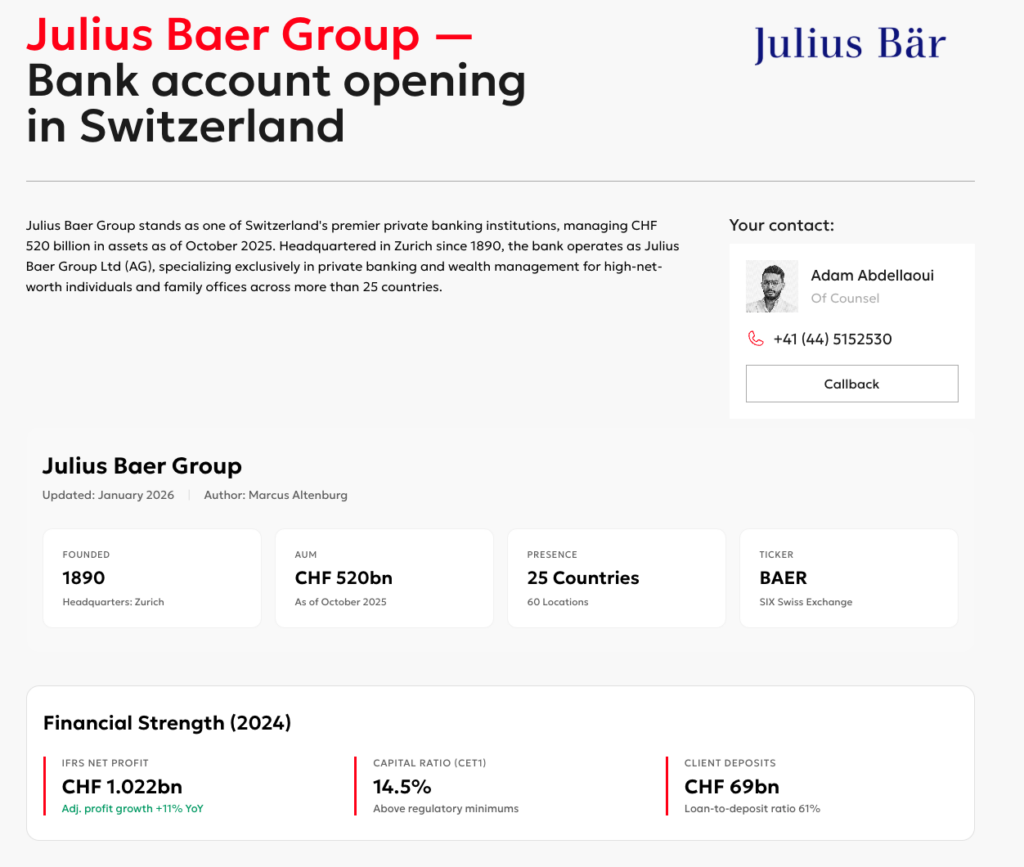
Google describes Julius Bär by using a goldblum.ch onboarding guide written about Julius Bär, not by it. The prospect reads a third-party account of the bank’s own account-opening process.
This is not a Julius Bär-specific problem. It is the structural condition of Swiss private banking in Google AI search.
What we measured
This study covers 1,036 relevance-filtered private-banking and wealth-management keywords. Keywords span French, German, and English. The study ran on the full Swiss market, national scope, across six topic categories.
This is the private banking counterpart to our regional retail studies. Same methodology, different buyer. The retail picture is in the French-speaking Switzerland study and the German-speaking Switzerland study.
This article stands alone.
What are Swiss private banking customers searching for?
Private-banking search in Switzerland organises around six distinct moments in the client journey. Each has a different intent profile, a different AIO trigger rate, and a different competitive structure.
| Category | Keywords | Share | AIO Rate |
|---|---|---|---|
| Private Bank Selection, Rankings & Discovery | 347 | 33.5% | 43.5% |
| Client Eligibility, Account Opening & Onboarding | 194 | 18.7% | 51.0% |
| Wealth & Asset Management Services | 215 | 20.8% | 44.7% |
| Investment Products, Strategies & Alternatives | 104 | 10.0% | 56.7% |
| Succession, Estate Planning & Wealth Transfer | 124 | 12.0% | 47.6% |
| Swiss Banking Context & HNW Wealth Literacy | 52 | 5.0% | 53.8% |
Private Bank Selection and Wealth & Asset Management together account for 54.3% of all queries.
These are the primary battlegrounds for AI-driven client acquisition. They are the moments where a prospect forms a shortlist and begins evaluating the service model.
The Swiss Banking Context category triggers an AI Overview 53.8% of the time. Queries like “Who typically uses private banking?” and “How confidential is private banking in Switzerland?” sit here.
They come from people who are newly curious about the sector, not existing clients. No private bank domain appears in the top five cited sources for it.
The non-resident and offshore thread runs distinctively through Account Opening. Queries like “Can I open a private banking account in Lausanne with CHF 2 million?” and “Kann ich als Deutscher ein schweizer Bankkonto haben?” come from international clients.
They represent a significant inbound channel for Swiss private banking. They are answered almost entirely by independent advisory sites, not the banks.
If the bank is absent from the AI answer at the selection moment, it is not on the prospect’s list.
How often does Google answer with AI and who does it cite?
Google triggers an AI Overview on 47.5% of private-banking queries in this study. That is 492 of 1,036 keywords.
It puts Swiss private banking above the German-speaking Switzerland retail benchmark of 21%, and in line with the French-speaking Switzerland benchmark of 48.4%.
Nearly half of all private banking searches in this market now return a generated answer before anything else.
Official bank domains account for only 25.5% of all AIO source citations. The remaining 74.5% goes to advisory intermediaries, comparison platforms, fee-based advisers, social and video channels, and independent publishers.
Here is the category-by-category picture.
Private Bank Selection & Comparison
Private Bank Selection, Rankings & Discovery: 347 keywords, 33.5% of all keywords in this study, 43.5% AIO trigger rate. Dominant intent: commercial (82.1%).
- Top 5 brands: Lombard Odier (58.9%), Pictet (58.9%), UBS (51.7%), Julius Bär (27.8%), UBP (18.5%)
- Top 5 source domains: pictet.com (31.8%), lombardodier.com (31.1%), ubs.com (13.9%), piguetgalland.ch (10.6%), ubp.com (10.6%)
This is the most commercially valuable category in the study. It matters most for client acquisition.
The Geneva private banks lead it. Lombard Odier and Pictet each appear in 58.9% of selection AI Overviews, seven percentage points ahead of UBS. On the queries that form a prospect’s shortlist, the Zürich-headquartered institutions are following Geneva’s lead.
Queries like “best swiss private bank“, “top private banks switzerland”, and “how to choose a private bank in switzerland” dominate this category. The same pattern holds in German (“beste privatbank schweiz“) and French (“classement banque privée suisse“). The AI answer for all of them runs through the same small group of domains.
The source layer tells the same story.
Pictet’s multilingual award-claim pages (“Beste Privatbank in der Schweiz und in Europa (2024),” “Meilleure banque privée de Suisse et d’Europe”) appear directly as AIO sources for “beste Privatbank” queries.
Piguet Galland, ranked 36th among Swiss private banks by assets under management at CHF 6.9bn, earns 10.6% domain citations in the selection category. Any private bank managing ten times Piguet Galland’s assets but absent from this list has made a content choice, knowingly or not.
Wealth & Portfolio Management
Wealth & Asset Management Services: 215 keywords, 20.8% of all keywords in this study, 44.7% AIO trigger rate. Dominant intent: informational (81.9%).
- Top 5 brands: UBS (25.0%), Lombard Odier (18.8%), Moneyland.ch (17.7%), Pictet (17.7%), VZ VermögensZentrum (13.5%)
- Top 5 source domains: moneyland.ch (15.6%), ubs.com (9.4%), lombardodier.com (8.3%), tareno.ch (8.3%), vermoegenszentrum.ch (8.3%)
Queries like “Who is the best Swiss wealth manager?“, “wealth management zurich“, and “gestion de fortune suisse” sit here.
So do higher-threshold queries like “How much money do you need for a family office?” and the German-language equivalent “Welcher Vermögensverwalter ist der beste?” These are the queries that represent a private bank’s core commercial proposition.
The third and fifth most visible brands in this category are not private banks. Moneyland.ch is a retail comparison portal. VZ VermögensZentrum is a fee-based independent advisor without a private banking licence.
Google treats both as equivalent to a private bank on wealth management queries. The reason: they publish the structured, comparative content that private banks have not matched.
VZ VermögensZentrum ranks ahead of Julius Bär, UBP, and every Swiss boutique on queries that represent the core service proposition of a private bank. Its domain, vermoegenszentrum.ch, is cited at 8.3%, matching Lombard Odier.
For any private bank’s wealth management content team, that is the benchmark to beat.
Account Opening & Eligibility
Client Eligibility, Account Opening & Onboarding: 194 keywords, 18.7% of all keywords in this study, 51.0% AIO trigger rate. Dominant intent: informational (71.1%) with significant transactional component (27.8%).
- Top 5 brands: UBS (48.5%), Lombard Odier (39.4%), Julius Bär (30.3%), Moneyland.ch (29.3%), Pictet (25.3%)
- Top 5 source domains: rivaria-capital.com (22.2%), goldblum.ch (20.2%), moneyland.ch (20.2%), wise.com (14.1%), alpian.com (12.1%)
Not one of the top five cited source domains is a private bank.
The queries driving this are direct: “What qualifies you for private banking?“, “How much money do you need to have for private banking?“, “Can I open a private banking account in Lausanne with CHF 2 million?“.
They also come in French (“Quel montant minimum pour ouvrir un compte en banque privée à Lugano ?”) and cover practical considerations like “private banking fees switzerland“. All of them are answered by intermediaries.
This is the most immediately winnable opportunity in the study.
Rivaria-capital.com, goldblum.ch, and Moneyland.ch have won this category by publishing what private banks have not. They offer specific, factual, CHF-threshold-by-city eligibility information.
They have non-resident account-opening guides and per-bank procedural content. Goldblum.ch publishes a per-bank onboarding guide for Julius Bär at goldblum.ch/banks/julius-baer-group. Julius Bär does not.
The AIO trigger rate here is 51.0%. The sources that earn citations are intermediaries.
Any private bank that publishes structured eligibility pages in French, German, and English enters a category where the current occupants have no institutional scale to defend their position.
The pages need to cover minimum thresholds, city-specific requirements, and non-resident eligibility.
Family Office & Succession
Succession, Estate Planning & Wealth Transfer: 124 keywords, 12.0% of all keywords in this study, 47.6% AIO trigger rate. Dominant intent: informational (62.1%) with significant commercial component (35.5%).
- Top 5 brands: UBS (33.9%), Lombard Odier (28.8%), VZ VermögensZentrum (27.1%), Pictet (22.0%), YouTube (15.3%)
- Top 5 source domains: ubs.com (22.0%), lombardodier.com (18.6%), youtube.com (18.6%), vermoegenszentrum.ch (16.9%), pictet.com (10.2%)
VZ VermögensZentrum ranks third on queries representing the highest-value client lifecycle moment for any private bank: business succession, intergenerational wealth transfer, inheritance structuring.
YouTube appears as both a brand at 15.3% and a source at 18.6%. AI answers for succession queries draw on video content as readily as editorial pages.
The queries here include “How do I plan the succession of my family business in Switzerland?“, “Welche Schweizer Privatbank berät Firmeninhaber zur Ausstiegsstrategie?“, and “Quelle banque privée pour la planification successorale à Zurich ?”
The families and business owners asking these questions are exactly the clients a private bank’s relationship managers spend years cultivating.
Google is giving them VZ VermögensZentrum and YouTube before it gives them a private bank succession specialist. The content gap is real. Relationship capital alone does not close it.
Fees & Performance
Fees and performance are not measured as a standalone category in this study.
The pattern across categories is consistent. Moneyland.ch earns its citations precisely because it publishes fee benchmarks and comparison content. Private banks do not produce that content in equivalent depth.
Moneyland.ch appears as a cited domain in 11.2% of all AIO responses. Queries like “private banking fees switzerland” sit inside the eligibility keyword set, where no private bank domain currently holds a top-five citation.
Whoever structures a clear, current fee comparison and publishes it in a structured format enters a near-empty source field on the queries where prospects are evaluating cost.
Safety, Stability & Regulation
Swiss Banking Context & HNW Wealth Literacy: 52 keywords, 5.0% of all keywords in this study, 53.8% AIO trigger rate. Dominant intent: informational (90.4%).
- Top 5 brands: J.P. Morgan (25.0%), Pictet (25.0%), UBS (25.0%), Lombard Odier (17.9%), Coutts (14.3%)
- Top 5 source domains: quora.com (17.9%), en.wikipedia.org (14.3%), moneyland.ch (14.3%), youtube.com (14.3%), facebook.com (10.7%)
This is the only category in the study where no private bank domain appears in the top five cited sources.
Quora, Wikipedia, Facebook, and YouTube lead citations on queries like “Is my money protected at a Swiss private bank?“, “Who typically uses private banking?“, and “How confidential is private banking in Switzerland?”
Those queries have direct brand-building value. They are asked by newly curious prospects, before any formal selection process begins, and no private bank is answering them.
No private bank has published an authoritative explainer on Swiss banking heritage and HNWI wealth management that Google trusts enough to cite. The category has no incumbent. The barrier to entering it is a single well-structured editorial page.
Does search intent change who Google cites?
Classifying the query set by search intent reveals three structurally distinct competitive environments.
| Intent | Keywords | AIO Rate | Top 3 brands | Top 3 source domains |
|---|---|---|---|---|
| Informational | 567 | 49.6% | UBS (28.8%), Lombard Odier (21.7%), Pictet (17.8%) | moneyland.ch (12.5%), lombardodier.com (10.7%), ubs.com (10.0%) |
| Commercial | 408 | 43.1% | Pictet (60.8%), Lombard Odier (58.5%), UBS (55.7%) | lombardodier.com (31.8%), pictet.com (29.5%), ubs.com (16.5%) |
| Transactional | 61 | 57.4% | UBS (60.0%), Lombard Odier (40.0%), Moneyland.ch (37.1%) | moneyland.ch (22.9%), ubs.com (22.9%), wise.com (22.9%) |
Commercial intent covers the queries where prospects are evaluating and comparing. It has the lowest AIO trigger rate at 43.1% but the most intense brand competition.
Pictet at 60.8%, Lombard Odier at 58.5%, and UBS at 55.7% are nearly tied for the top three positions. The Geneva houses have built their strongest structural AIO advantage precisely on the queries that drive actual selection decisions.
Transactional intent shows the most alarming third-party intrusion. Moneyland.ch at 37.1% and Alpian at 25.7% rank third and fourth on queries with the highest conversion intent.
When a prospect moves from research to action, non-bank intermediaries appear in the AI answer alongside or ahead of private banks.
Take “Can a non-resident open a private banking account in Geneva?” as a working example. The conversion moment is being intermediated.
Informational intent is where third-party voices dominate by volume. Moneyland.ch at 15.7% brand visibility matches Julius Bär at 12.1% across informational queries. The informational layer is also where most of the query volume sits: 567 of 1,036 keywords. Dominance in this layer means dominance in the discovery phase of the private banking funnel.
How HNW and UHNW clients use AI to choose a private bank
The buyer’s research has moved upstream of the relationship. This section does not exist in the retail articles because the dynamic is specific to wealth management. The implications for content strategy are different, and the stakes are higher.
Prospects form a consideration set from AI answers before any relationship manager is engaged. The first impression of a 200-year-old institution is now an AI paragraph it did not write.
The relationship manager learns about the prospect’s interest, if at all, after the AI has already framed the competitive landscape. At that point, the shortlist is already narrowed.
The gatekeeper layer matters as much as the prospect. A significant share of Swiss private banking inflow comes through intermediaries: family offices, independent asset managers, and external advisors who screen banks on behalf of clients.
These professionals will increasingly turn to AI search as part of their due diligence process. They run the same queries and evaluate the same AI answers before recommending any bank to a client.
The audience for the AI Overview is often not the end client. It is the professional who decides whether to put the bank on the list at all. Being absent from AI answers means being absent from both the direct prospect’s shortlist and the intermediary’s recommendation.
Reputational due diligence is another layer.
AI search surfaces stability, regulatory, and reputational signals. The Swiss Banking Context category shows what this looks like in practice. Quora, Wikipedia, Facebook, and YouTube are the sources Google draws on for queries like “which bank do millionaires use?“.
A private bank that has not published its own authoritative answer to those questions has ceded the reputational narrative to platforms it cannot influence.
Then there is what might be called discretion as a content liability.
The cultural reflex to publish little is sound private banking practice with two centuries of precedent. It is also the direct cause of source invisibility.
Google cannot cite what the bank will not write. Edmond de Rothschild manages about CHF 170bn and publishes market commentary, CIO letters, and fund insights for existing investors.
What it does not publish is the comparison and eligibility content that Google’s AI pulls from when a prospect asks which bank to choose. Its AIO presence is approximately 0%. The connection is not coincidence. It is mechanism.
The bank’s editorial footprint is now part of its first impression with money it wants to manage. A bank that publishes comparison-structured content, eligibility guides, and market insight articles has a first impression partly authored by its own domain.
A bank that publishes brochures and product PDFs has a first impression authored by goldblum.ch, rivaria-capital.com, and Moneyland.ch.
Who is the most visible private bank in Google AI search?
Across all 492 AI Overview responses in this study, three private banks have built genuine dual presence: named in the AI answer and cited as a source domain. The rest either appear as names only, or do not appear at all.
The visible leaders, and what AUM does not buy
| Bank | AUM 2025 | Overall AIO Brand Visibility | Domain Citation Rate |
|---|---|---|---|
| UBS | CHF 5,584bn | 40.7% | 13.2% |
| Lombard Odier | CHF 174bn | 36.2% | 17.9% |
| Pictet | CHF 724bn | 33.7% | 13.0% |
| Julius Bär | CHF 477bn | 18.7% | ~0% (not in top 20 domains) |
| UBP | CHF 144bn | 10.8% | present across 5 categories |
| Piguet Galland | CHF 6.9bn | 7.7% | 10.6% (selection category) |
| Maerki Baumann | CHF 11.2bn | 7.1% | cited for award queries |
UBS has the broadest presence: 40.7% of all AI Overview responses, present across all six categories. But this is not a UBS dominance story.
On the queries that drive actual client acquisition, the commercial intent and selection category, Lombard Odier and Pictet lead.
Lombard Odier is the most cited private bank domain in the study at 17.9% of all AIO responses. It gets there by publishing city-level location pages, thematic service pages, and market insight articles.
That is a content architecture Google’s AI can draw from regardless of query intent.
Visibility tracks editorial investment, not assets under management. Piguet Galland, ranked 36th among Swiss private banks by assets under management, earns 7.7% overall brand visibility and 10.6% domain citation rate in the selection category.
Maerki Baumann, ranked 29th among Swiss private banks by assets under management, earns 7.1% brand visibility through structured award-claim pages.
Both outperform institutions managing 10 to 30 times their assets. Content strategy, not institutional scale, determines AI Overview presence.
The invisible prestige houses
Edmond de Rothschild manages about CHF 170bn and has a Geneva headquarters comparable in prestige to Lombard Odier and Pictet. Its AIO presence is approximately 0%.
No page from edmond-de-rothschild.com appears in the source citations across all 492 triggered responses.
What EdR publishes, and publishes actively, is market commentary for existing investors: Market Flash updates, CIO letters, fund insights at edmond-de-rothschild.com/en/news.
What it does not publish is the comparison and eligibility content that AI search pulls from when a prospect asks which bank to choose.
There is no fee guide, no eligibility threshold page, no “how to choose a private bank” resource. Google cannot build a prospect-facing AI answer from investor relations content. The 0% AIO presence is the direct consequence.
LGT, the Liechtenstein royal family’s bank managing CHF 117bn, earns essentially zero overall AIO brand visibility. It appears in one category, Investment Products, at 10.2% brand visibility.
That proves its domain infrastructure can earn citations. The capability simply has not been extended to selection, eligibility, or wealth management queries.
HSBC Private Bank has CHF 81bn in assets under management in Switzerland and a Geneva booking centre. Its consumer brand recognition is global. Its private-banking AIO presence in Switzerland is 0%.
VP Bank manages CHF 51bn from Vaduz and has strong Liechtenstein brand presence. Its AIO presence in Swiss private banking search is 0%. Vpbank.com does not appear in any AIO source citation.
EFG International manages CHF 143bn from Zürich. It does not appear in the top brand list. Efginternational.com appears in one source citation for a Lugano location query.
These are not small, niche institutions.
They are among the largest private banks in Switzerland and Liechtenstein. Managing hundreds of billions in client assets does not put you in Google’s AI answer about your own market.
The root cause is the same one that runs through every retail study in this series. Product-and-prestige sites with no editorial layer, no comparison content, and nothing the AI can parse earn no citations.
Mentioned everywhere, cited nowhere
Safra Sarasin manages CHF 209bn, the fifth largest institution on the monitored list. It earns 4.3% brand visibility in this study, rank 19 overall.
Jsafrasarasin.com earns zero source citations. Safra Sarasin is being named in AI answers while all of those answers are sourced from third parties. The bank exists as a noun in Google’s output. It has no editorial authority behind that noun.
Julius Bär is the sharpest version of this problem. It appears as a named brand in 18.7% of all 492 AI Overview responses, rank 4 overall. Juliusbaer.com does not appear among the top-20 cited source domains.
Google names Julius Bär in nearly one in five AI answers, and the content behind those answers comes from goldblum.ch, not from Julius Bär itself.
Being a noun in the answer and being an authority behind it are not the same thing. The banks with dual-layer presence, brand mention and domain citation, shape their own narrative in the AI answer. The banks that are only nouns let third parties shape it for them.
The gap is not algorithmic. It is editorial.
What content earns Google AI mentions and citation in Swiss private banking?
The same finding running through the retail studies holds here, and the data is specific enough to name it precisely.
Format earns mention and citations. Not brand size, not AUM, not institutional prestige.
The domains earning the most AIO citations in Swiss private banking share four structural content patterns.
1. Award-claim pages in multiple languages.
Pictet’s “Beste Privatbank in der Schweiz und in Europa (2024)” page and its French equivalent appear directly as AIO sources for commercial selection queries.
Maerki Baumann’s Bilanz 2024 award page earns citations for the same query type. UBS operates the same pattern with its Euromoney award page.
These pages work because they combine a specific, credible claim with a query-matching title.
Any private bank with an Euromoney, PWM, Bilanz, or International Banker award that has not published a structured award page is leaving its strongest competitive asset off the AI table.
2. City-specific eligibility and service pages.
Lombard Odier earns 17.9% of all AIO domain citations, the highest of any private bank domain, through a content architecture built around city-level contact and service pages.
It rests on three deliberate, repeatable content patterns.
City-level location pages.
Lombard Odier maintains a dedicated page for each Swiss office, built on a single systematic URL pattern, /{language}/home/contact/private-clients/{city}.html, published in French, German, and English. For example:
- https://www.lombardodier.com/home/contact/private-clients/geneva.html
- https://www.lombardodier.com/fr/home/contact/private-clients/zurich.html
- https://www.lombardodier.com/de/home/contact/private-clients/zug.html
- https://www.lombardodier.com/fr/home/contact/private-clients/lausanne.html
Because each city, and each language variant of it, has its own page, the bank captures the full set of “private bank in [city]” queries across Switzerland’s language regions, rather than relying on a single generic location page.
Thematic service pages.
Clear, single-topic pages map each core service to the question a prospect would ask. The /private-clients.html hub is in fact the single most-cited Lombard Odier page in the entire study, supported by focused pages such as:
- https://www.lombardodier.com/fr/home/private-clients/wealth-management.html
- https://www.lombardodier.com/…/discretionary-portfolio-management.html
- https://www.lombardodier.com/…/private-clients/lombard-loans.html
Market-insight articles.
A steady stream of editorial articles answers the informational questions buyers ask before choosing a bank, and the article titles mirror those questions almost word for word:
- …/insights/2026/march/how-to-choose-the-private-bank.html
- …/insights/2026/january/the-advantages-of-private-banking.html
- …/insights/2026/april/private-banking-for-hnwi.html
- …/insights/2025/april/private-banking-in-switzerland.html
The pattern that ties it together: Lombard Odier wins AI Overview citations by matching page structure to query structure.
Geographic queries are met with systematic per-city, per-language pages; service queries with one clean page per service; and informational queries with articles whose titles echo the exact phrasing of the question.
This question-to-page alignment, not the sheer volume of content, is what earns the citations.
3. Front-loaded, entity-dense editorial.
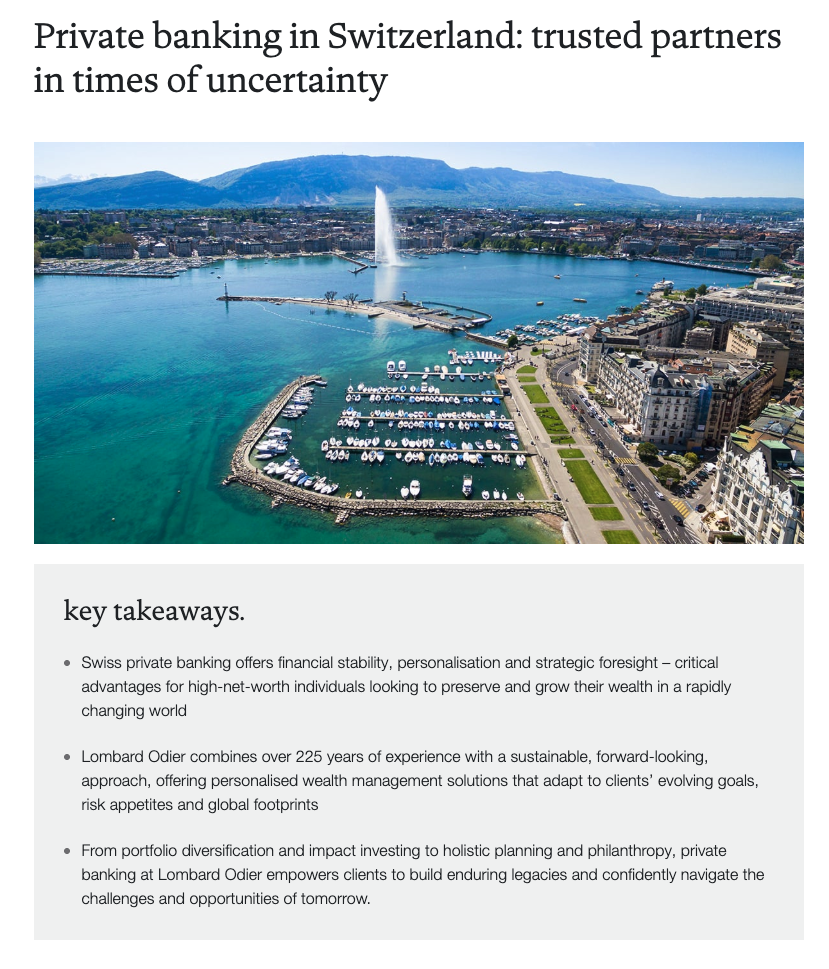
AI search reads the opening of a page most heavily. Lombard Odier’s insight article “Private banking in Switzerland: navigating market swings for long-term wealth” earns citations across multiple distinct query categories, both location-intent and topic-intent queries.
One well-structured insight article matching core private-banking topics can appear across six categories simultaneously. The pages that earn this breadth lead with named banks, mandate types, and fee figures in the first 200 words, not brand narrative.
4. Third-party-style transparency content.
Moneyland.ch earns 11.2% of all AIO citations because it publishes structured fee comparisons, eligibility criteria, and bank comparisons that private banks have not produced in equivalent format.
Rivaria-capital.com earns 4.9% because it publishes detailed non-resident account-opening guides for Swiss private banking.
The pattern is consistent: editorial transparency earns citation trust.
The intermediaries win because they compare the market instead of selling one bank. A private bank publishing the same structural transparency, named comparisons, and explicit thresholds competes directly with these intermediaries.
And it does so with the domain authority the intermediaries lack.
What should Swiss private banks do now?
Five moves. Each is specific to a gap in the data. Each is executable this quarter.
1. Publish structured award-claim pages for every award you hold, in all languages you operate in.
The gap: Maerki Baumann (CHF 11.2bn AUM) and Piguet Galland (CHF 6.9bn AUM) are earning citations that institutions ten times their size are not.
The common factor is structured award pages with query-matching titles.
The move: create one page per award in French, German, and English. Title it as “Award Name, Bank Name, Year.” The indicator it worked: your page appears as an AIO source citation on “beste Privatbank” queries within 60 days.
2. Build city-level private banking eligibility pages for every city where you have a booking centre.
The gap: Client Eligibility triggers AIO 51.0% of the time and is sourced entirely from intermediaries: rivaria-capital.com, goldblum.ch, and Moneyland.ch.
The move: publish structured pages per city covering minimum AUM thresholds, non-resident eligibility, required documents, and account-opening process. Title each page “Private Banking in [City]: Account Opening and Eligibility.”
The indicator it worked: your domain displaces at least one intermediary from the AIO source list within 90 days.
3. Produce deep succession and estate planning editorial that explicitly names your expertise.
The gap: VZ VermögensZentrum, a fee-based adviser without a private banking licence, appears in 27.1% of succession AI Overviews. Private banks are absent from the answers on their own core service.
The move: publish step-by-step guides on business succession, intergenerational wealth transfer, and inheritance under Swiss law. Frame them as buyer’s guides, not capability brochures.
The indicator it worked: vermoegenszentrum.ch drops from the top three cited sources in Succession queries within two content cycles.
4. If you earn brand mentions but zero domain citations, ship one structured comparison page.
The gap: Safra Sarasin at 4.3% brand visibility and zero domain citations, and Julius Bär at 18.7% brand visibility and zero top-20 domain citations, illustrate the split.
The move: one page, structured as a comparison covering mandate types, fee ranges, minimum AUM, and city coverage. Front-load named entities and figures.
The indicator it worked: your domain appears in the AIO source list within a single monitoring cycle.
5. For the invisible prestige houses, the investment is content architecture, not brand budget.
Edmond de Rothschild, LGT, HSBC Private Bank, VP Bank, and EFG are not missing from AI answers because they lack brand recognition.
They are missing because they do not publish content in the format Google’s AI uses to build answers.
The brand does not need rebuilding. The editorial layer does. LGT is the specific case that proves this: it earns 10.2% brand visibility in the investment-products category because it already publishes content Google trusts for that topic.
The move is to extend that same content architecture to selection, eligibility, and wealth management queries. The benchmark already exists in the data: lombardodier.com’s city-and-service content model.
The strategic playbook for doing this across all five content gaps, and tying it to your broader marketing funnel, is in our guide to winning AI search in Swiss banking.
To build the editorial layer from the content gaps up, the fastest starting point is to build your marketing funnel from the data.
To Conclude
The core finding is not that UBS leads in Swiss private banking AI search. That is expected from an institution with CHF 5,584bn in assets and a content architecture spanning awards, products, and insights.
The finding is different.
The most prestigious houses in Swiss private banking manage hundreds of billions and have operated in Geneva, Zürich, and Vaduz for generations. They are named everywhere and cited nowhere.
A retail comparison portal and a fee-based advisory firm write the AI answers that prospects read about them.
Edmond de Rothschild, LGT, HSBC Private Bank, VP Bank, and EFG are absent from AI answers entirely. Safra Sarasin is present as a noun and absent as an authority. Julius Bär is named in nearly one in five AI answers and sourced in none of them.
These are not algorithm quirks. They are the direct consequence of content decisions, or the absence of them.
The banks that appear as sources chose to answer client questions in writing, at scale, in a format that is structured and current. That choice is still available to the banks that have not made it.
The window is open.
The positions in Swiss private banking AI search are not yet locked. The Investment Products category has a 56.7% AIO trigger rate and no dominant source.
The Swiss Banking Context category has a 53.8% trigger rate and no private bank domain in the top five citations.
The first institutions to publish structured, entity-dense, comparison-oriented content in these categories will define how Google’s AI answers for the rest.
The prestige will still be on the letterhead. The question is who authors the first impression.