
The Best Strategy for Swiss Banks to Win AI Search in 2026
If you are looking for an AI search strategy for Swiss banks, this is the article.
Not a theory piece about where search is heading, a playbook built from actual data, two original studies, and five sequenced plays your team can start executing this quarter.
We analyzed 723 banking keywords across French- and German-speaking Switzerland in Google AI search and found clear patterns in who gets cited, who gets mentioned, and why most Swiss bank websites are absent from both layers.
The headline: non-bank sources — comparison platforms, independent blogs, French aggregators, and a German consumer finance brand — account for 75 to 78% of all AI source citations.
Swiss bank websites, as a category, are almost entirely absent from the source layer.
The patterns are consistent enough across both linguistic markets that an AI search strategy for banks can be built directly from them.
Here is what the data shows:
- Three in four AI citations in both Swiss markets go to third-party voices, not to banks
- Brand mentions and domain source citations move on separate tracks: a bank can appear in 30% of AI answers while its website earns zero source citations
- Format, not brand size, determines which sites get cited, and four content formats win consistently across both linguistic markets
- Five executable plays close the gap, sequenced by return on effort
This is the third piece in the series. The two regional studies are the proof. This is the playbook.
What two studies tell us about Swiss bank Google AI Search performance
We analyzed who is the most visible Swiss bank in Google AI search. The answer is not what most CMOs expect.
Two original studies, 374 banking keywords in French-speaking Switzerland and 349 in German-speaking Switzerland, examined which domains Google cites as sources in AI Overviews, which brands appear as mentions, and what content formats earn citations.
Combined: 723 keywords, every major retail banking category: savings, mortgages, pensions, investing, account opening, and banking safety.
The assumption that market leaders dominate AI search the way they dominate brand awareness fails on contact with the data. What the studies found is the warrant for every play that follows.
Google AI Overviews are the AI-generated answer blocks that appear at the top of search results before any website link. They cite source domains, the URLs Google’s AI used to compose the answer.
They also name brands inside the answer text without necessarily citing those brands’ domains as sources.
Pour choisir une banque en Suisse, l’offre dépend de votre profil. Neon et Yuh conviennent aux profils mobiles sans frais de tenue de compte. UBS offre une gamme complète pour les clients souhaitant un accompagnement en agence. Pour les épargnants, les taux varient entre 1.0% et 1.5% selon les établissements.
This article uses “AI Overviews” and “Google AI Search” interchangeably. The distinction between being named in the answer text (a brand mention) versus having your domain listed as a source (a domain citation) is the structural concept the entire playbook turns on.
Who actually wins today: the top 5 banks and top 5 sources in each market
Before the analysis, the names. Here is who Google’s AI is naming inside its answers and which domains it is citing as sources.
In French-speaking Switzerland (374 keywords), the top 5 brand mentions are
- UBS (35.9%),
- Yuh (27.1%),
- Neon (22.7%),
- Raiffeisen (19.9%),
- and Banque Migros (18.8%).
The top 5 source domains are
- ubs.com (15.5%),
- moneyland.ch (11.0%),
- mustachianpost.com (8.8%),
- alpian.com (8.8%),
- and thepoorswiss.com (8.3%).
One bank-owned domain leads the source list. The other four are a comparison platform and three independent blogs.
In German-speaking Switzerland (349 keywords), the top 5 brand mentions are
- UBS (39%),
- Migros Bank (33%),
- Yuh (28%),
- Neon (25%),
- and Raiffeisen (25%).
The top 5 source domains are
- wise.com (19%),
- raiffeisen.ch (13%),
- ubs.com (12%),
- zkb.ch (12%),
- and vermoegenszentrum.ch (9%).
The top source is a foreign fintech publishing German-language content about Swiss banking.
Two patterns jump out before any deeper analysis. UBS is on both lists in both markets, the only bank with that dual-layer presence.
And the brand top 5 and the source top 5 barely overlap. The brands customers see inside the answer are mostly not the domains Google is reading to build it. That gap is what the rest of this section unpacks.
Finding 1 — Three out of four AIO citations go to non-bank sources
Official bank websites account for only 25% of AI Overview source citations in German-speaking Switzerland. Three in four citations go to third-party voices. In French-speaking Switzerland, non-bank sources take 78.2% of all citations.
In FR-CH, aggregators and comparison sites hold 23% of citations, independent finance blogs 20.2%, broker/advisory sites 12.6%, news and press 10.6%.
Official brand websites sit at 21.8%, and nearly half of all banking-related searches in French-speaking Switzerland now surface an AI-generated answer before any website.
In DE-CH, comparison platforms hold 19%, independent blogs 14%, expat and advisory sites 12%, media 10%, institutional sources 6%.
The foreign platform problem is worth sitting with comparabanques.fr and banque.meilleurtaux.com each earn 13.5% of commercial-intent AI source citations in French-speaking Switzerland, French aggregators with no Swiss regulatory grounding, co-authoring the AI answer a Swiss customer receives when they type “quelle banque choisir en Suisse.“
In German-speaking Switzerland, wise.com earns 19% of all AI Overview source citations across five of six categories. finanztip.de, a German consumer finance brand, earns 18% of Investments category citations.
Swiss banks are not losing to better-resourced competitors. They are losing to faster-moving content publishers who understood format requirements first.
Brand leadership and content leadership are not the same thing, and the gap is measurable.
Finding 2 — Brand mentions and source citations move on different tracks
Brand mention is the primary KPI: it means Google’s AI is naming your bank in front of customers who are actively researching a purchase.
Getting mentioned in AI Overviews is the headline win. Source citation is the next level on top of that, the move that turns awareness into authority by placing your domain inside the answer itself.
The most striking example from DE-CH: Yuh appears in 28% of all AI Overview responses. That is a strong brand presence.
yuh.com does not appear as a source domain anywhere in the corpus, which means the next move for Yuh is clear.
The same pattern holds in FR-CH, where Neon and Yuh each appear in 37.8% of commercial-intent responses and 57.1% of transactional-intent responses.
Combined with Revolut and BoursoBank, the four brands generate 165 brand mentions. Zero combined domain citations. The mention foundation is there; the source citation layer is not built yet.
Then there is BCGE. The largest retail bank headquartered in Geneva, the largest city in French-speaking Switzerland, earns 0% brand mentions and 0% source citations across all 374 French-language keywords.
Not low presence. None.
That is a different problem from the mention-without-citation pattern, and it requires a different starting point.
The dual-layer exception is UBS.
UBS earns 35.9% brand visibility across all FR-CH AI Overview responses, and ubs.com is cited as a source in 15.5% of all AI-Overview-triggered keywords in that market.
In DE-CH: 39% brand visibility, 12% domain source citations.
UBS is the only bank in either corpus with meaningful presence on both layers in both markets.
Raiffeisen achieves the strongest alignment model in DE-CH for transactional intent: raiffeisen.ch appears simultaneously as the top brand (60%) and top source domain (60%) in that intent category.
Migros Bank earns 60% brand citation and 40% domain citation in transactional queries, the alignment model every brand in this market should be replicating.
Source citation is the second-level move that compounds the mention win.
Most Swiss banks already have brand presence in AI Overviews. The strategic question is whether to build the citation layer on top of it.
Finding 3 — Format wins. Brand doesn’t. In either language.
Brand size, domain authority, and marketing budget do not earn AI Overview citations. Content format does. That sentence appears in both studies and it is the pivot from diagnosis to playbook.
Four content formats earn citations consistently across both markets:
Structured comparison and rate table pages
- moneyland.ch earns 11% of all FR AI-Overview-triggered keywords, 30% of Savings citations in FR-CH, and 33% in DE-CH.
- hypotheke.ch earns 38% of Mortgage AI Overview source citations in DE-CH and 7% of all DE AI Overview responses.
- comparabanques.fr earns 13.5% of commercial-intent FR citations, ranking from France.
The pattern: named banks with fee and rate figures, neutral editorial position, updated regularly.
Regularly updated rate pages with dedicated URL structures
- ca-nextbank.ch earns 25% of Savings AI Overview source citations in FR-CH from a single rate page.
- hypotheke.ch/vergleich-zinsen-hypothek/ holds 38% of Mortgage citations in DE-CH.
- moneypark.ch earns 15.6% of Mortgage citations in FR-CH and 15% in DE-CH.
The pattern: a self-descriptive URL, monthly updates, structured data, not a product page.
Independent editorial voice with front-loaded entity density
- mustachianpost.com earns 33.3% of Investing AI Overview source citations in FR-CH, more than Pictet, UBS, Lombard Odier, or any of the private banks whose names dominate the brand mentions column.
- thepoorswiss.com earns 16.3% of Bank Selection citations in FR-CH and 19% of Account Opening citations in DE-CH. The blog answers the question the reader typed. The private bank website describes the bank.
Fintech brands publishing market-wide competitor comparisons
finpension.ch earns 21.7% of Pension source citations in FR-CH and 17% in DE-CH through pages that explicitly compare finpension against VIAC and other bank 3a providers, naming competitors.
Google cites the page that answers the user’s question, not the page that sells the product.
These formats win because Google treats editorial transparency as a trust signal that institutional brand voice does not generate.
The banks that break through, UBS, Raiffeisen, ZKB, do so because their content behaves like the winning third-party formats. The format requirement is not a mystery. It is documented.
The 2026 GEO playbook: five plays for any Swiss bank
The five plays below are sequenced by return on effort.
- Plays 1 to 4 apply to most Swiss banks: retail, commercial, cantonal, and digital.
- Play 5 addresses the specific position of cantonal banks, where the opportunity and the constraints differ.
Each play follows the same structure: the gap, the move, the proof, the indicator.
Play 1 — Publish a structured savings rate comparison page on your own domain
The gap
- Savings Accounts (FR-CH) has the highest AI Overview trigger rate in the FR-CH corpus: 58.8%.
- More than half of all savings-related searches in French-speaking Switzerland now produce an AI answer.
- moneyland.ch leads source citations with only 30% visibility; no other domain exceeds 25%.
Google is actively answering savings questions and has not yet found a bank it is willing to cite. That is an open door.
The move
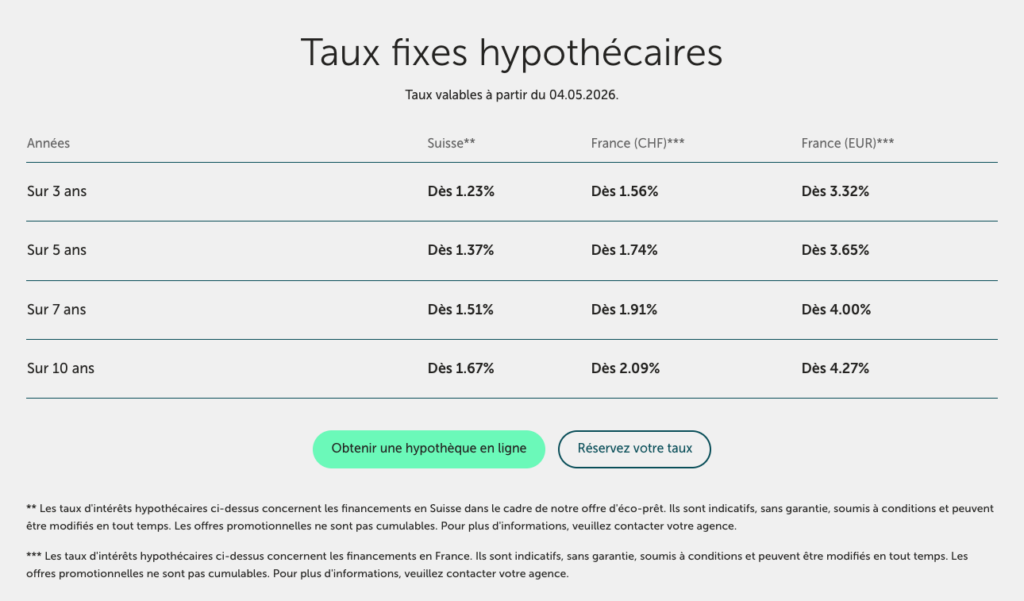
- Publish a dedicated savings rate comparison page, not a product page.
- Name competitors’ current rates alongside yours, use a structured format, and update monthly.
- The URL should describe the content:
/comparatif-taux-epargne/or/spar-zins-vergleich/. The page is about the savings rate market in Switzerland, with your rate in it.
The proof
- ca-nextbank.ch earns 25% of Savings AI Overview source citations in FR-CH from a single, dedicated rate page
- moneyland.ch earns 30% through a structured comparison format. Neither has the brand visibility of ZKB or UBS. Both have content structured the way AI can parse.
The indicator
- Within 90 days of publishing the page and updating monthly, your domain should appear as a source citation in at least one Savings-related AI Overview in your market.
- Track this manually by running savings queries in Google and checking the AI Overview source list, or use an AI Overview monitoring tool.
- The benchmark to beat is 5% category source share, the level at which competitors start to notice your presence.
Play 2 — Build a structured mortgage rules-and-rates hub
The gap
- Mortgages triggers AI Overviews in 57.1% of FR-CH searches. In DE-CH, hypotheke.ch holds 38% of Mortgage AI Overview source citations with a single structured rate comparison page.
- moneypark.ch and resolve.ch each hold 15.6% in FR-CH.
- Swiss bank mortgage pages, by contrast, describe affordability criteria and invite visitors to contact a relationship manager. Google does not cite a page that ends with “call us.”
The move
- Build a mortgage hub that functions as the answer to “wie funktioniert eine Hypothek in der Schweiz?” or “comment fonctionne un crédit hypothécaire en Suisse?“, complete with current indicative rates by type (fixed, SARON, variable), a benchmark of what regional competitors offer, LTV requirements under Swiss regulation, and the key FINMA rules a buyer needs to know.
- The hub is a structured information resource, not a loan application landing page. It earns citations when it answers questions. Conversions are the downstream effect.
The proof
- hypotheke.ch/vergleich-zinsen-hypothek/ earns 38% of Mortgage AI Overview citations in DE-CH. resolve.ch earns 15.6% in FR-CH. moneypark.ch earns 15% in DE-CH.
- None of them has a Swiss bank’s distribution, regulatory credibility, or rate access. They win because they answered the question.
A Swiss bank with all those structural advantages is currently losing to them anyway. That should bother someone.
The indicator
- Within 90 days of publishing the hub, check whether your domain appears as a source in AI Overview responses to mortgage queries in your market.
- Run 15 to 20 representative mortgage queries manually and note which domains the AI cites.
The benchmark: hypotheke.ch holds 38% in DE-CH and resolve.ch holds 15.6% in FR-CH. Any Swiss bank mortgage hub that answers the same questions with current rates should be able to break 5% category source share within a quarter of launch.
Play 3 — Reframe pension content from product page to buyer’s guide
The gap
- Pension and Säule 3a (DE-CH) triggers AI Overviews in 50% of searches, the highest category rate in the DE-CH corpus.
- In that category, zurich.ch and swisslife.ch each earn 33% of Pension AI Overview source citations. Insurance brands are co-authoring the AI answer about Swiss bank pension products.
- In FR-CH, the same dynamic: mustachianpost.com earns 33.3% of Investing AI Overview source citations, more than any private bank’s own domain.
The blog answers the question the reader typed. The private bank website describes the bank. That sentence describes most Swiss bank pension pages accurately.
The move.
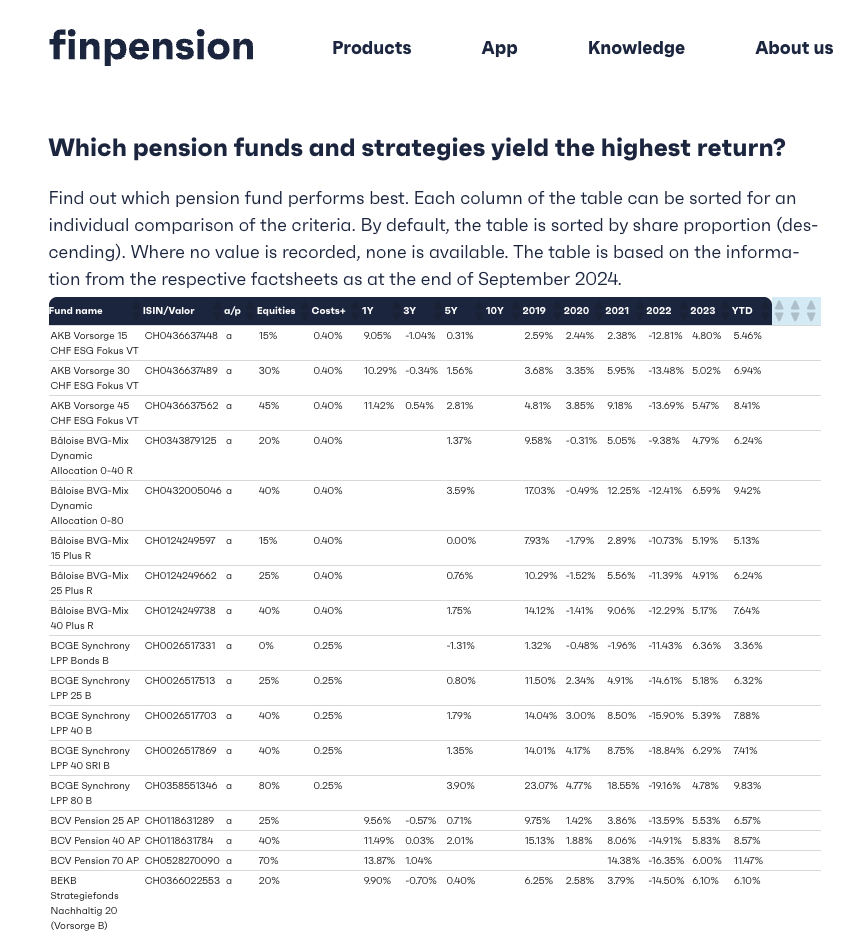
- Take your top Säule 3a or pension product page. Rewrite the opening 200 words to: name at least three competitor providers with fee or return figures, answer the question the reader typed before describing your product, and disclose your selection criteria.
- The page becomes a buyer’s guide that opens with the market, then positions your product within it. Reformat the content from product brochure to buyer’s guide and the sourcing gap closes.
The proof
- finpension.ch earns 21.7% of Pension AI source citations in FR-CH and 17% in DE-CH through pages that explicitly compare finpension against competitors.
- vermoegenszentrum.ch earns 36% of Investments AI citations in DE-CH and 9% of all DE AI Overview responses.
- Both name competitors. Both earn citations that bank product pages cannot.
The indicator
- Entity density in the opening 200 words is the concrete measure. Count how many named competitors and fee or return figures appear above the fold.
- Target: at least three named competitors with one data point each, visible before any product description. If that content is not there, the page will not be cited regardless of domain authority.
- Check quarterly and update as competitors change their fee structures.
Play 4 — If you get brand mentions but zero source citations, publish one comparison page
The gap
- BCV earns 10.5% brand visibility across all 374 FR-CH keywords and 30.8% in the Banking Safety category. bcv.ch earns 0% source citations across all 374 keywords.
- That ratio, solid brand visibility with zero sourcing, is the most common pattern in the corpus. It applies equally to LUKB (23% brand visibility in Mortgages DE-CH, effectively 0% source citations) and Neon (25% brand in DE-CH, 0% source citations)
The structural cause is always the same: the bank publishes content that describes itself, not content that answers the user’s question.
The move
- Audit which categories your brand is mentioned in but your domain is not cited. Pick the highest-volume category with this pattern.
- Publish one comparison page in that category: structured, named competitors, current figures, self-descriptive URL. One page, correctly formatted, can shift the source citation figure materially.
This is not a content volume problem. It is a content format problem.
The proof
- neon-free.ch earns 8% of all AI source citations directly. The page reads like a comparison page: named features, fee statements, neutral editorial position.
- Neon is a neobank competing against ZKB and UBS on brand but winning on content format. postfinance.ch earns 6.1% of all FR AI-Overview-triggered keywords cross-category, not from product pages, from informational content structured to answer questions.
The indicator
- Source share versus mention share by category.
- For each major product category, record brand mention rate and domain citation rate separately.
- Any category with mention share above 10% and citation share below 2% is a Play 4 candidate. Run this audit quarterly.
- One new comparison page per quarter in a qualifying category is a realistic pace for most marketing teams.
Play 5 — The cantonal bank variant
The gap
The pattern across the cantonal bank category is consistent and severe.
- BCGE earns 0% brand mentions and 0% source citations across all 374 FR-CH keywords. BCV earns brand presence but 0% source citations.
- BEKB, the cantonal bank for Bern, the city that houses FINMA and the Swiss National Bank, earns 0% brand mentions and 0% source citations across all 349 DE-CH keywords.
- AKB, the Aargauer Kantonalbank serving one of Switzerland’s most populous cantons, earns the same: 0% brand, 0% source.
- LUKB earns 23% brand visibility in Mortgages but a single source citation across the entire DE-CH corpus.
- ZKB is the exception: zkb.ch earns 12% of all DE AI Overview responses, with meaningful brand visibility across Savings (44%), Account Opening (31%), Mortgages (31%), and Pension (50%).
Competitive positions are less entrenched precisely because the other cantonal banks are absent. The window is open, and nobody is moving through it.
The move
Cantonal banks carry institutional credibility that comparison platforms and foreign aggregators simply do not have: state guarantees, FINMA supervision, regional mandate. That credibility is not yet expressed in content.
Build a Banking Safety and Trust hub covering deposit guarantees (esisuisse coverage and the cantonal state guarantee where applicable), FINMA supervision, regulatory protection under Swiss law, and plain-language answers to what happens in a resolution scenario.
The proof
- The Banking Safety category in FR-CH triggers AI Overviews in 56.5% of searches, above mortgages, above investing. moneyland.ch and ubs.com tie as top sources at 23.1% each; thepoorswiss.com holds 15.4%.
- The regulatory sites FINMA (finma.ch) and bwo.admin.ch account for only 7.7% each. The category is actively searching for an authoritative Swiss banking voice.
- Cantonal banks, as state-backed institutions, are structurally positioned to be that voice. They are currently absent.
One additional alignment: FINMA’s guidance (08/2024) identifies transparency and explainability as governance requirements for AI use inside institutions.
A cantonal bank that publishes clear, structured content about banking safety is expressing externally the same institutional discipline regulators require internally. The content play and the regulatory posture are the same move.
The indicator
- Banking Safety category source share. Is your domain cited in AI responses to queries about deposit guarantees, esisuisse, FINMA supervision, and cantonal state guarantees?
- Run 10 to 15 representative queries manually and check the source list in each AI Overview.
The benchmark: moneyland.ch holds 23.1% and no cantonal bank currently appears.
Breaking into the top three sources in this category, at roughly 7 to 10% source share, is achievable within two quarters of publishing a well-structured hub.
Market Gap
present.
How to sequence the work over 12 months
The five plays are not equal effort. Here is the realistic sequencing.
Months 1 to 3:
Play 1 (savings rate comparison page) and Play 4 (one comparison page where brand mentions exceed source citations). Both are a single, well-formatted page. Both can be produced with a few weeks.
These establish the baseline for what structured content looks like on your domain and give you an early AI sourcing signal to validate the approach.
Months 3 to 6:
Play 2 (mortgage hub). More input required: current rates by type, competitive benchmarking, regulatory information.
Worth the lead time because Mortgages triggers AI Overviews in 57.1% of FR-CH searches and hypotheke.ch already holds 38% of DE-CH mortgage citations with a single dedicated URL.
The category is not saturated from the bank side.
Months 6 to 9:
Play 3 (pension buyer’s guide). This requires the most structural revision because existing pension pages are the furthest from the required format. Frame it internally as a rewrite project, not a new page.
The URL and the product stay the same; the content format changes.
Months 9 to 12:
Play 5 (Banking Safety hub) for cantonal banks; continued optimization and expansion for others. The Banking Safety hub is high-value but requires legal and compliance review. Build it right rather than fast.
The one-sentence answer to “what should Swiss banks do now?“: start with the category where your brand is mentioned but your domain is not cited. That gap is the diagnostic, the investment case, and the starting point.
Where to start this week
Pull a sample of 100 to 200 banking queries in your primary market: savings, mortgages, pensions. Check which ones trigger an AI Overview.
For each that does, note whether your brand is mentioned and whether your domain is listed as a source.
Build the mention-vs-citation matrix for your own bank. That audit takes one analyst one day. The result tells you exactly which of the five plays to start with.
In German-speaking Switzerland, at 21% overall AI Overview trigger rate, positions are not yet locked in.
The banks that move now will shape how Google answers for years. In French-speaking Switzerland, positions are more established, which is why the comparison page plays are time-sensitive.
The marketing funnel for Swiss banking customers does not start where it used to. If you want a structured walkthrough of which plays apply to your bank’s specific AI search strategy, we run that as part of Funnel as a Service.